Wondering when should mosquito treatments begin in spring? Timing is key for a pest-free yard. Learn the ideal temperature and conditions to start. Conta...
How Aeration Improves the Results of Your Fertilization Program
 At ALCS Lawncare, we often get asked whether fertilization alone is enough to keep a lawn healthy, or whether it needs to be paired with something else to actually work as intended. The honest answer is that fertilization performs best when the soil underneath it is actually able to receive what is being applied. That is where aeration and fertilization together make such a noticeable difference. In this article, we want to explain why we recommend combining these two services rather than treating them as separate, unrelated tasks, and how this pairing connects directly to our fertilization program.
Why Soil Condition Determines Fertilizer Performance
Fertilizer only works as well as the soil allows it to. Nutrients need to reach the root zone to be useful, and in a lot of lawns, especially ones with heavy foot traffic, clay soil, or several years without any soil work, the ground becomes compacted enough that water and nutrients struggle to get past the surface layer. When that happens, a portion of every application ends up running off, evaporating, or sitting unused near the top of the soil instead of reaching the roots where it is actually needed.
This is really the core reason we talk about combining services rather than treating fertilization as something that works the same way on every lawn regardless of soil condition.
Why Aerate Before Fertilizing
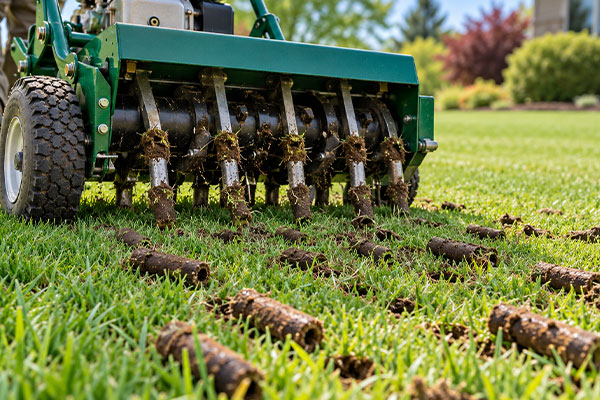
The order of operations matters here. Aerating before a fertilizer application creates small channels in the soil that allow nutrients, water, and air to move more freely down to the root system. Without that step, a fertilizer application on compacted soil is working against a barrier that limits how much of it actually gets absorbed.
A few reasons aerating first tends to produce better outcomes include:
- It breaks up compacted soil layers that block nutrient movement
- It creates direct pathways for fertilizer to reach the root zone instead of sitting on the surface
- It allows water to penetrate more evenly, which helps distribute nutrients after application
- It reduces surface runoff, so less product is wasted during rain or irrigation
We usually recommend our lawn aeration service shortly before a scheduled fertilizer treatment for exactly this reason. The timing between the two does not need to be exact down to the day, but keeping them close together in the same service window tends to produce noticeably better results than spacing them months apart.
Maximizing Lawn Treatment Results Through Combined Services
When we talk about maximizing lawn treatment results, we are really talking about making sure the work already being done is not being undercut by something happening below the surface. A lawn can receive a full season of fertilizer applications and still underperform if compaction is limiting how much of that product ever reaches the roots.
Combining lawn care services in the right sequence changes that equation. Instead of fertilizer competing against compacted soil, aeration clears the way first, and the fertilizer that follows has a much better chance of being absorbed where it matters.
This becomes even more relevant on lawns that also deal with thinning grass or bare patches. In those cases, we often pair aeration with overseeding as well, since the same channels that help fertilizer reach the roots also give grass seed better soil contact. Our aeration and overseeding service is built around this exact idea, addressing compaction and thin coverage at the same time rather than treating them as two separate problems.
How Improving Nutrient Absorption in Soil Affects the Rest of the Season
Once nutrient absorption improves, the effects tend to show up in more than just the immediate weeks after treatment. Here is how we generally see it play out over a full season:
- Roots develop more deeply since nutrients and water are reaching them consistently
- The lawn becomes more resilient to short term heat and drought stress
- Grass density improves gradually, which naturally reduces space available for weeds
- Later fertilizer applications become more effective, since soil structure has already improved
- Overall lawn color and consistency tend to even out across the property
This is part of why we think of aeration less as a one-time fix and more as a foundational step that supports everything else in a fertilization program. A lawn with healthy soil structure simply gets more value out of every application that follows.
Signs Your Lawn May Need Aeration Alongside Fertilization
Not every lawn needs aeration on the same schedule, but there are a few signs that usually point toward compaction being a limiting factor. We look for things like:
- Water pooling on the surface after rain instead of soaking in
- Grass that feels thin or spongy in high traffic areas
- Visible thatch buildup near the base of the grass blades
- Soil that feels hard or resistant when a screwdriver or probe is pushed into it
- Fertilizer applications that do not seem to produce the expected improvement in color or growth
If several of these apply to a lawn, it is usually a sign that fertilization alone is not getting the full result it should, and that soil compaction is playing a role.
Addressing Pests Alongside Soil and Nutrition Work
Soil health does not exist in isolation from pest pressure either. Compacted, stressed lawns tend to be more vulnerable to certain pests, and grub activity in particular can undo a lot of the progress made through aeration and fertilization if it goes unaddressed. We often recommend checking for grub activity as part of a broader seasonal plan, and pairing that inspection with our grub control service when needed, so root development is not being undermined from below while the rest of the program is working from above.
Why We Recommend Treating These as One Connected Plan
We understand that from a homeowner or property manager’s perspective, aeration and fertilization can look like two separate line items on a service list. In practice, though, we find that treating them as one connected plan produces more consistent results than scheduling them independently. Fertilization delivers the nutrition, and aeration makes sure the soil is actually capable of using it.
If you want to see how this combined approach has worked on other properties, our recent projects section includes examples of lawns that went through this exact pairing over the course of a season.
Getting Started
If your lawn has been on a regular fertilization schedule without the improvement you expected, soil compaction is worth ruling out before assuming the fertilizer itself is the issue. We would be glad to take a look at your property and let you know whether aeration should be part of the plan. You can reach out to our team through our contact page, or visit alcslawncare.com to learn more about how we approach combined lawn care services across our service area.
Frequently Asked Questions
1. Why aerate before fertilizing instead of after?
Aerating first creates channels in the soil that allow the fertilizer applied afterward to reach the root zone more directly, rather than sitting on a compacted surface where it is more likely to run off or evaporate before being absorbed.
2. How often should aeration and fertilization be combined? This depends on the property, but many lawns benefit from aeration once or twice a year, timed close to a scheduled fertilizer application, especially if the soil shows signs of compaction or heavy traffic.
3. Will fertilization still work if I skip aeration?
Fertilization can still provide some benefit without aeration, but on compacted soil, a significant portion of the product may not reach the roots effectively, which limits how much improvement you see over time.
4. How do I know if my lawn has compacted soil?
Common signs include water pooling instead of soaking in after rain, grass that feels thin or spongy underfoot, and soil that feels hard when probed. A physical inspection is the most reliable way to confirm compaction.
5. Can aeration and overseeding be done at the same time as fertilization?
In many cases, yes. Aeration creates the right conditions for both fertilizer absorption and seed-to-soil contact, which is why we often coordinate these services within the same seasonal window.
Related Posts